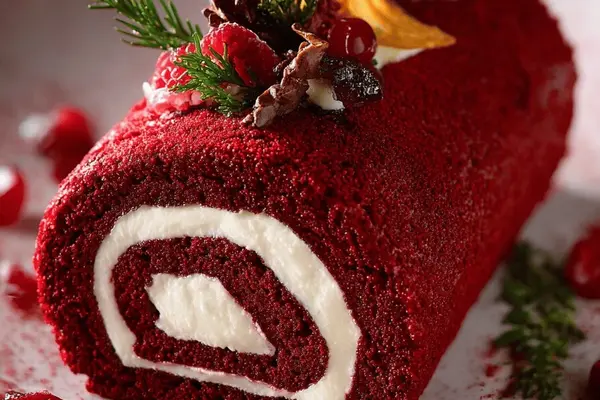
Red Velvet Yule Log with Italian Meringue
By Emma
Certified Culinary Professional
·
Recipe tested & approved
Forty-five minutes to prep, twenty-five in the oven, but the meringue—that’s where the actual magic happens. Red velvet cake wrapped around itself with Italian meringue, the kind that doesn’t weep or collapse. Tried this once with buttercream. Wrong. This is better.
Why You’ll Love This Red Velvet Yule Log
Holiday dessert that actually looks like you know what you’re doing. Almond extract instead of vanilla changes everything—deeper, quieter, more interesting than the basic version. Two thin cake layers instead of one thick one means they stay tender all the way through. Italian meringue is more stable than you’d think—won’t weep if you don’t refrigerate it, holds texture for hours. Dark chocolate undertone with that red color playing against it works. Not overly sweet. Rolls without cracking if you time the cooling right. Can make it the morning of and serve the same night.
What You Need for Red Velvet Cake Roll with Almond Flavoring
All-purpose flour—280 ml. Cocoa powder, 65 ml. Baking soda, just 3 ml. Six whole eggs plus five yolks, which sounds like a lot but it’s the structure. Sugar, 250 ml. Grapeseed oil—not olive, not vegetable. Grapeseed. It stays neutral and doesn’t compete with the almond. Red food coloring, liquid kind, 16 ml. White vinegar, 15 ml. Almond extract, 5 ml, and this is non-negotiable. Changes the whole thing from “red velvet cake” into something with actual depth.
For the meringue: water, 80 ml. Light corn syrup, 150 ml. Five egg whites. That’s it. No cornstarch, no powdered sugar, none of that stabilizer stuff people throw in. Italian meringue doesn’t need it if the syrup temp is right.
How to Make Red Velvet Yule Log
Oven to 175°C. Center rack. Two baking sheets lined with parchment, then greased. Not just parchment—greased. Sticky cake skin is its own problem.
Sift flour, cocoa, baking soda together. Three times. Sounds excessive. Isn’t. Lumps ruin texture. Set aside.
Take whole eggs, yolks, sugar into a sturdy bowl. High speed mixer, 8 to 12 minutes. Watch it. After a few minutes it goes pale. Keep going. It’ll triple. That’s when you know. The ribbon test—when the whisk comes up, the batter falls off in ribbons that hold their shape for a second, then melt back in. That’s the mark.
Drizzle grapeseed oil in slowly while mixing. Then fold in red dye, vinegar, almond extract. Medium speed, just until it’s all one color. Don’t overmix. The whole point of all that beating was air. Overfolding collapses it.
Fold the dry stuff in now with a whisk. Gently. Once you can’t see flour streaks anymore, stop. Spread it onto the sheets—thin and even. Edges a little thinner than the middle, they’ll rise the same. Tap the pan to pop air bubbles.
Bake 14 to 17 minutes. Touch the top. Should spring back. Edges pull clean from the sides. Use a toothpick. Crumbs, not wet batter. Don’t overbake. Cracks when rolling means it’s already too done.
Cool on racks five minutes. Flip onto fresh parchment. Peel the paper off the top immediately—don’t wait. Sogginess happens fast. Drape a clean towel over it loosely. Let it cool completely to touch.
How to Get Red Velvet Cake Roll with Italian Meringue Perfect
Water and corn syrup together in a saucepan. Medium-high heat. Candy thermometer in—don’t stir it, just watch. 114°C. That’s the target. Watch for dark amber. That means it’s caramelizing and if you miss it by a few degrees you get hard, crystallized syrup instead of spreadable meringue. Pull it off heat the second it hits temp.
While that’s heating, beat egg whites at low speed to soft peaks. Fluffy but still wet-looking. When the syrup’s ready, pour it in slow and steady while the mixer’s on high. Thin stream. This part matters. Too fast and you cook the eggs unevenly. Keep beating 12 to 18 minutes. It’ll go from glossy to thick. Like stiff mountains. No stickiness when you touch it.
Rub a tiny bit between your fingers. Grainy means keep going or start over. Takes longer in humid weather. Shorter on dry days. Just know this going in.
Use it right away. Meringue deflates if you let it sit.
Trim the cake edges so they’re even. Peel the parchment off the top if it’s still stuck—spray a little water and peel slow. Lay both cakes lengthwise, seam in the middle. Spread 20% of meringue on each one, thin layer. Not thick. Thick means the log splits when you roll it.
Roll the first cake from the short side, tight but not crushing it. The parchment helps support. Move slow. Repeat with the second cake. Then nestle the second roll on top of the first so you get one long log shape.
Two spatulas to move it. Careful. No sudden moves. Transfer to the serving plate.
Coat the whole thing with the rest of the meringue. Use a spatula or palette knife. Push it around to make it look like bark. Rough texture, uneven. That’s the point.
Leave it at room temperature. Up to four hours. It’ll firm up. Don’t refrigerate. Sugar dissolves in cold, meringue weeps. Defeats the purpose.
Red Velvet Yule Log Tips and Common Mistakes
Chocolate cake with Italian meringue is forgiving if you understand one thing: the cake and meringue are separate problems. Solve each one independently, then combine them.
Cake cracks when rolling because it cooled too long or it was overbaked. Five minutes on the racks, then peel the paper. Too much longer and it dries out, gets stiff, snaps when you bend it. Damp towel over it while cooling helps. Light damp. Not soaked.
Meringue won’t hold peaks if the syrup wasn’t hot enough or you didn’t beat it long enough. 114°C is the number. Use a real thermometer. Guessing doesn’t work. If it’s gritty after 18 minutes of beating, the syrup temp was off. Start over.
Almond extract can go a different direction—pure vanilla works, orange blossom water too if you want something lighter. Vanilla’s safer. Almond’s better.
Grapeseed oil swap for light olive oil or avocado. Just watch the flavor. Avocado’s strong. Might push back against the almond.
Red food coloring—liquid works best. Gel’s thicker, changes moisture balance. Liquid beet juice concentrated works too if you’re avoiding dye, but adjust quantity. More liquid. Dries the cake out if you add too much.
Italian meringue’s the stable version. Swiss meringue can work but Italian’s heat-treated so it holds better. Not grainy, spreads cleaner, doesn’t weep as easy.
Room temperature eggs beat faster, reach ribbon stage quicker, give more volume. Cold eggs drag. Makes a difference.
Humidity matters. Stale, dry air, meringue dries fast. Humid day, it takes longer and might not firm up the same way. Nothing you can control. Just know it.
Serve same day. Use a serrated knife. Wipe it clean between cuts so the layers stay defined and don’t smear.
Red Velvet Yule Log with Italian Meringue
Prep:
45 min
Cook:
25 min
Total:
1h 10min
Servings:
8 servings
Ingredients
- Cakes
- 280 ml (1 1/8 cup) unbleached all-purpose flour
- 65 ml (4 1/2 tbsp) cocoa powder
- 3 ml (1/2 tsp) baking soda
- 6 large eggs
- 5 large egg yolks
- 250 ml (1 cup) granulated sugar
- 45 ml (3 tbsp) grapeseed oil
- 16 ml (1 tbsp + 1 tsp) liquid red food coloring
- 15 ml (3 tsp) white vinegar
- 5 ml (1 tsp) almond extract
- Italian Meringue
- 80 ml (1/3 cup) water
- 150 ml (2/3 cup) light corn syrup
- 5 large egg whites
Method
- Cakes
- 1 Start with oven rack centered. Heat to 175 °C (347 °F). Line two baking sheets with parchment paper; then grease well to avoid sticky, shredded cake skin later.
- 2 Sift together flour, cocoa powder, baking soda – triple sifting keeps lumps out, textures even. Set aside.
- 3 In sturdy bowl, whip whole eggs, yolks, and sugar at high speed. Watch closely. After 8-12 minutes, mixture should be pale, tripled, ribbon consistency when beaten falls off the whisk slowly, holds shape.
- 4 Slowly drizzle grapeseed oil, then fold in red dye, vinegar, and almond extract – I swapped vanilla for almond to deepen aroma without extra liquid. Mix medium speed until uniform.
- 5 Now, gently fold dry ingredients with a whisk; don't over-mix or will deflate. Fold just enough to see no flour streaks. Spread evenly onto sheets – spread edges thinner for uniform rising. Tap pan lightly to release air bubbles.
- 6 Bake 14-17 minutes. Use visual and tactile cues; spring back slightly when touched, edges pull clean from sides, top set but still soft. Insert tester toothpick; crumbs but not wet batter means ready. Don't overbake or it cracks when rolling.
- 7 Cool on racks 5 minutes. Flip cake out onto fresh parchment. Peel off the top paper immediately to prevent sogginess. Cover loosely with clean towel. Cool completely to touch. If cooled too long, cover lightly with damp tea towel to prevent drying.
- Italian Meringue
- 8 Combine water, corn syrup in saucepan. Heat over medium-high until candy thermometer reads 114 °C (237 °F) – watch carefully; dark amber tones signal caramelization starting; remove immediately to avoid hard crystallized syrup.
- 9 While syrup heats, beat egg whites at low speed to soft peaks. When syrup hits temp, pour in slow steady stream into whites while beating high speed. Keep whisking 12-18 minutes till thick, shiny, forming peaks that stand tall like stiff mountains, with no stickiness.
- 10 Test meringue by rubbing a bit between fingers; shouldn't feel grainy. If gritty, keep beating or start over. Use immediately as meringue deflates if left too long.
- Assembly
- 11 Trim odd edges of cakes. Remove top parchment from each cake piece gently; if stuck, moisten with water sprayed lightly, then peel.
- 12 Lay cakes lengthwise, side by side, seam in middle. Spread 20% of meringue evenly over each sheet, thin layer – too thick, and the log will burst when rolled.
- 13 Roll first cake tightly from short side, careful not to crack. Use parchment to help support the roll, moving slowly. Repeat with second cake, then nestle the second roll onto the first to create a large log.
- 14 Transfer log carefully onto serving plate with two spatulas, no sudden moves.
- 15 Smother remaining meringue around the log’s surface in thick coat, using spatula or palette knife to create bark-like ridges and texture.
- 16 Leave uncovered at room temperature up to 4 hours to firm up meringue. Don't refrigerate or the sugar may dissolve, meringue weeps.
- 17 Serve same day for best texture. Use a serrated knife wiped clean after each cut to preserve layers.
- 18 If meringue begins to weep, fluff with electric mixer briefly before serving.
- Substitutions and Tips
- 19 Grapeseed oil can swap for light olive oil; avocado oil also works but watch flavor neutrality.
- 20 Almond extract swap: pure vanilla or a touch of orange blossom water for different aromatic kick.
- 21 If red food coloring unavailable liquid beet juice (concentrated) or gel dye can be used; adjust quantity to avoid soggy cake.
- 22 For non-Italian meringue method – Swiss meringue can substitute but Italian's heat-treated syrup gives better stability for spreading and holding shape.
- 23 If eggs at room temp, beat faster to reach ribbon stage quickly; cold eggs slow and yield less volume.
- 24 Freezing cake layers before rolling can help reduce cracking but hard to beat freshness and flexibility of just-cooled sponge.
- 25 Humidity shifts the meringue time needed; stale, dry days speed drying out – adjust beating and storage accordingly.
Nutritional information
Calories
340
Protein
8g
Carbs
48g
Fat
12g
Frequently Asked Questions About Red Velvet Yule Log
Can I make the cake layers ahead of time? Yeah. Cool them completely, wrap loosely, leave at room temp up to eight hours. Don’t refrigerate or they get dry. Beyond that they’re staling fast.
What if my meringue starts weeping after I plate it? Grab the electric mixer. Beat it briefly to fluff it back up. Usually works. Means it sat in cold or humidity shifted.
Do I have to use liquid red food coloring? Gel works. Adjust down a bit. Beet juice concentrated works too but more of it needed, cake gets wetter.
Why almond extract instead of vanilla? Tastes deeper. Less one-dimensional. Vanilla’s fine if you want the basic version but almond changes it into something with actual character.
Can I refrigerate the finished yule log? Don’t. Sugar dissolves, meringue breaks down, whole thing weeps. Room temp up to four hours. Serve the same day.
What’s the easiest way to roll this without cracking? Cool exactly five minutes on the racks. Peel the paper immediately. Use the parchment to help support while rolling. Slow and steady. The cake’s still warm enough to flex, not so warm it’s floppy. That window’s tight. Get it right and rolling’s easy.
Can I swap the grapeseed oil? Light olive oil works. Avocado’s strong—use it if you want that flavor there. Vegetable oil’s fine but tastes like nothing, doesn’t enhance anything.
How long does the meringue actually take to beat? 12 to 18 minutes. Humidity changes it. Dry day, closer to 12. Humid, closer to 18. Stop when it’s thick, shiny, stands in stiff peaks. Test it—rub some between your fingers, shouldn’t feel grainy.
You’ll Love These Too
Explore all →
Lemon Mascarpone Cannoli Recipe
Lemon Cream Cheese Pie No-Bake Recipe
Bulgur Chicken Soup with Spiced Tomato Broth
Spanish Potato Omelet with Manchego Cheese
Cold Rotini Salad with Mozzarella & Pepperoni

Mini Chicken Pot Pies with Cheddar Biscuits
Roasted Chicken With Couscous and Harissa
Foie Gras Appetizer with White Wine
Egg Muffins with Prunes and Applesauce
Herb Garlic Salt with Chive Flowers
Lemon Ginger Chicken Thighs with Greek Yogurt

No Bake Cheesecake Recipe with Fresh Strawberries
Sirloin Steak with Mushrooms and Tomato
Sesame Salmon Wonton Soup Recipe

Red Sangria Recipe with Elderflower
Chicken Wing Rub with Paprika & Cayenne
Sautéed Cauliflower Rice with Lemon
Brown Sugar Pecan Cake with Butter
Dark Chocolate Ganache with Coconut Cream