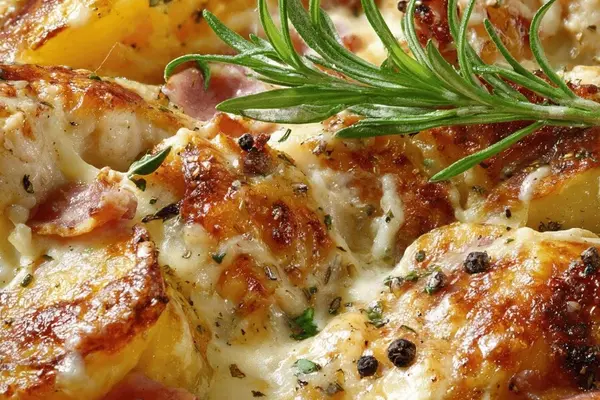
Creamy Ham and Potato Bake with Brie
By Emma Kitchen
Certified Culinary Professional
·
Recipe tested & approved
Creamy ham and potato bake layered with russet potatoes, chicken, shallots, and melted brie cheese. Rich comfort food dish that’s perfect for any meal.
Prep:
30 min
Cook:
55 min
Total:
1h 25min
Servings:
6 servings
Preheat to 190. Potatoes go in cold water—that’s the thing nobody tells you. Twenty-five minutes until they’re firm but not falling apart. This is a ham and potato bake that actually tastes like someone spent time on it, except you don’t really spend time on it at all.
Why You’ll Love This Comfort Food Potato Bake
Sits in the oven and basically finishes itself. One hour twenty-five minutes total and most of that’s just waiting. Comes out golden, creamy, the brie gets all melty and kind of pools into everything else. Tastes like the thing your grandmother made but better because there’s brie. Cheese on top, cream underneath—no such thing as dry here. Makes enough to feed six people or three people who really want leftovers. Cold the next day it’s almost better. Completely different texture.
What You Need for a Layered Ham Potato Casserole
Russets. Not Yukon Gold. The starch matters—they hold together instead of getting mushy. About 1.1 kilograms. Unpeeled. The skin stays on.
Cooked ham works best. Three hundred grams, sliced thin. You could use chicken—that’s actually what’s happening here in the original, and it works fine. Cold or room temp, doesn’t matter.
Two large shallots. Not onions. Shallots are sweeter, less aggressive. Slice them thin. White wine—120 milliliters. Not the expensive stuff. Not the cheap stuff either. Something you’d actually drink. Heavy cream, 250 milliliters. The full fat kind.
One whole brie. Cut it in half horizontally—this matters because you want it to melt into layers instead of just sitting on top. Salt and black pepper. Butter, 20 grams. That’s not much. Just enough.
How to Make a Potato Bake with Brie and Cream
Start with cold water and potatoes. Seems wrong. It’s not. The heat goes in gradually, so the inside cooks at the same rate as the outside. Salted water. Bring it to a boil. This takes maybe fifteen minutes. Then twenty-five minutes simmering. You check with a knife—it should go through with just a little resistance. Not a fork. A knife. Forks lie.
Drain them. Let them cool enough to handle—fifteen minutes is right. You want them cool but not cold. Slice them into centimeter rounds. Not thinner. Thinner turns into mush.
Skillet. Medium heat. Melt the butter. Add the shallots. Don’t rush this. They need to go soft and golden, which takes maybe eight minutes. You’re not browning them, just making them sweet and kind of translucent at the edges.
Pour the wine in. This is the moment it smells like something’s actually happening. Let it cook down until it’s almost gone—three minutes, four minutes. The alcohol evaporates. What’s left is flavor.
Add the ham. Stir it once. Season it. Salt, pepper. That’s it. Remove from heat. Let it sit.
How to Get Your Ham and Potato Casserole Golden and Perfect
Baking dish. Layer half the potatoes on the bottom. Flat. They can overlap a tiny bit but not stack. The shallot and ham mixture goes next. Spread it out. Not clumpy. Then the rest of the potatoes on top.
Pour the cream over everything. Pour it slow. It should seep down but also stay on top a little bit. Then the brie halves, rind side up. This is what makes it work. The rind holds together while everything underneath gets creamy and soft.
Set the whole thing on a baking sheet—catch drips—and into the oven at 190 degrees Celsius. Fifty minutes. The top should be golden brown. The edges should be bubbling slightly. If it’s pale at forty-five minutes, give it five more. If it’s dark, check it at forty. Every oven is different.
Pull it out. Let it rest ten minutes. Not optional. The cream needs to set up slightly or it pours right off onto your plate. Ten minutes. That’s when you plate it.
Potato Bake Tips and Common Mistakes
Don’t use thin-sliced potatoes thinking they’ll cook faster. They won’t. They’ll just fall apart and turn into mashed potatoes mixed with cream, which sounds good but isn’t the same thing. One centimeter. Measure it once, then you remember.
The ham needs to be cooled slightly before assembly. Hot ham in the middle layer means the cream curdles around it. Let it sit in that pan for a few minutes after you remove the heat.
Brie should be cold from the fridge. Room temperature brie melts completely and disappears instead of creating this layer that you can actually taste. Cold brie stays intact while the heat softens it. Different texture.
The wine really does need to evaporate almost completely. Too much liquid and the whole thing is soup instead of creamy and bound. You’ll see it—when the pan goes quiet after sizzling, that’s when you know.
Shallots versus onions—tried onions once. Too sharp. Doesn’t work the same way. Shallots have this sweet note that makes sense with the brie.
Creamy Ham and Potato Bake with Brie
Prep:
30 min
Cook:
55 min
Total:
1h 25min
Servings:
6 servings
Ingredients
- For the base
- 1.1 kg Russet potatoes, unpeeled
- 300 g cooked chicken, sliced thin
- 2 large shallots, thinly sliced
- 20 g unsalted butter
- 120 ml white wine
- For the topping
- 1 whole brie cheese, cut in half horizontally
- 250 ml heavy cream
- For seasoning
- Salt and black pepper to taste
Method
- Cooking the potatoes
- 1 Preheat the oven to 190 °C.
- 2 Place potatoes in a pot with cold salted water.
- 3 Bring to a boil. Cook for about 25 minutes.
- 4 Check tenderness with a knife. Should be firm but tender.
- 5 Drain and let cool for 15 minutes.
- Preparing the layers
- 6 Slice the potatoes into 1 cm rounds.
- 7 Heat a skillet over medium heat.
- 8 Melt butter. Add shallots and cook until soft and golden.
- 9 Pour in wine. Cook until it evaporates.
- 10 Add chicken slices, season, and mix. Remove from heat.
- Assembling the bake
- 11 In a large baking dish, layer half of the potatoes.
- 12 Add the shallot and chicken mix on top.
- 13 Layer the rest of the potatoes.
- 14 Pour the cream evenly over everything.
- 15 Place the halved brie on top, rind side up.
- 16 Set on a baking sheet.
- 17 Bake for 50 minutes until golden brown.
- 18 Let it rest for 10 minutes before serving.
Nutritional information
Calories
540
Protein
18g
Carbs
56g
Fat
28g
Frequently Asked Questions About Ham and Potato Bake
Can I use canned potatoes or instant mashed potatoes instead? No. The structure is the whole point. Canned potatoes turn to mush. Fresh russets hold their shape and that’s what makes this different from a side dish.
How do I know if the potatoes are done boiling? Knife test. Cut one in half. Should go through with just a little push. Not a fork—they give too easily and lie about doneness.
Can I assemble this the night before? Yeah. Layer it all in the dish, cover it, refrigerate. Add five to ten minutes to the baking time since it goes in cold.
What if I don’t have brie? Other soft cheeses work—camembert, if you can find it. Something creamy that melts. Not cheddar. That’s a different casserole. Regular baked potato with ham and cheese is different.
Can I use ham instead of the— Wait, the recipe has ham already. If you want more ham, use more. Double it. Probably works fine.
How long does it keep? Three days refrigerated. Reheats okay in a 160-degree oven, covered, until it’s warm. Not the same as fresh but it’s not bad either.
Do I really need to let it rest ten minutes? Yeah. The cream sets up. Serve it right out and it’s creamy but loose. Ten minutes and it’s actually structured. Makes sense when you eat it.
Can I use lighter cream or milk instead of heavy cream? Tried it. Doesn’t have the same richness. It’s thinner. Bake goes longer because it doesn’t coat things the same way. Heavy cream is the thing here. Not negotiable.
You’ll Love These Too
Explore all →
Air Fryer Quiche with Bacon and Kale
Crispy Ranch Potatoes
Duck Breast Red Wine Cocoa with Kale
Crispy Beer-Battered Chicken Thighs with Dill Pickle

Gingerbread Men Cookies with Cream Cheese

Cheesy Garlic Meatball Bites with Pizza Dough
Macaroni Cheese in a Crock Pot

Shortbread Millionaire with Lemon Glaze
Rustic English Scones with Sour Cream

Sesame Salmon Edamame Bowl Recipe

Herb Cheese Biscuits with Fresh Thyme

Green Fizz Twist Cocktail with Mezcal

Rice Krispie Treats with Peeps & Sea Salt
Tagliatelle with Fennel, Walnuts & Raisins

Garlicmayo Recipe with Sunflower Oil

Oatmeal Peanut Butter Balls

White Chicken Chili Crockpot with Turkey

Maple Glazed Oatmeal Cookies with Cinnamon
Pumpkin Cream Cheese Dip Recipe