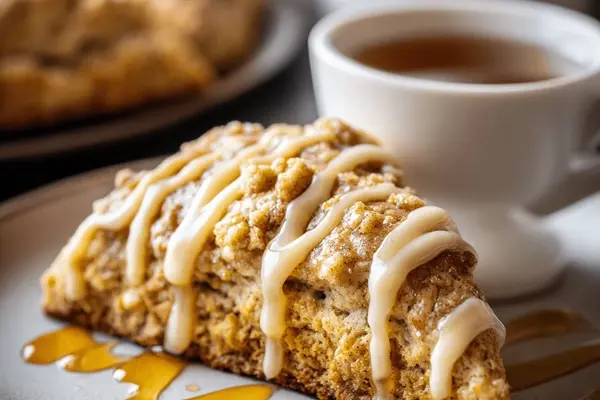
Cinnamon Scones with Honey and Ginger
By Emma
Certified Culinary Professional
·
Recipe tested & approved
Butter’s supposed to stay cold. That’s the whole thing. Press the dough once, fold it, spice it, stack it — then into the fridge. Fifteen minutes later they come out with cracks across the top and layers that actually separate when you pull them apart. This is how cinnamon scones work.
Why You’ll Love These Cinnamon Scones
Warm breakfast that tastes homemade because it is. Takes 35 minutes of actual hands-on work, then 15 in the oven.
Flaky layers. Not cakey. The folding and the cold butter make them break apart in pieces, not crumble into dust.
Cinnamon and ginger layered through — not just sprinkled on top. You get spice bursts instead of one-note sweetness.
Honey in the dough keeps it moist longer than sugar alone. Leftovers don’t go hard.
Works cold the next day. Maybe better. Still has structure.
No buttermilk needed. Honey does the work.
What You Need for Cinnamon and Sugar Scones
Bread flour. Not all-purpose. More gluten means better structure, more chew.
Cold unsalted butter. Diced small. The pieces stay distinct in the dough — that’s where the layers come from.
Honey. Warmed just enough that it pours but still cool enough the butter won’t melt into it. About 35 seconds in the microwave. Not hot.
Light brown sugar mixed into the dry ingredients first. Spreads the sweetness evenly instead of pooling.
Baking powder and baking soda together. The soda needs something acidic to react with — the honey gives you that. Use both or they don’t rise right.
Ground cinnamon and ginger. Keep them separate from the flour at first. You’re going to sprinkle them layered into the dough later, not mixed in. Cinnamon and ginger scones need that texture.
Dark brown sugar for the glaze. Melted butter brushed on top so it sticks and caramelizes. The crunch matters.
How to Make Cinnamon Scones
Flour, sugar, baking powder, salt, baking soda — mix them dry first. Really mixed. The rising agents need to be everywhere or you get dense patches. Do this in a bowl or a food processor. Doesn’t matter much.
Dice the cold butter small. Toss it into the flour. Work it with a pastry cutter or pulse it in the processor until it looks like peas. Not powder. Not chunks either. Pea-sized. You want it to stay cold and separate — that’s what makes layers later.
Warm the honey. Just warm. Thirty seconds in the microwave. Add it to the flour mixture. Fold. Don’t stir. Fold with a spatula, gently, until the flour disappears but the dough still looks rough and shaggy. Stop before it gets smooth. Overmixing kills scones.
Turn it onto a floured surface. Press and fold it onto itself. Fold the bottom up. Fold the sides in. Fold it maybe six times. You’re not kneading — you’re folding. The folds create layers. Shape it into a square, roughly 9 by 9 inches. Doesn’t have to be perfect.
How to Get Cinnamon Scones Flaky and Spiced Right
Sprinkle the cinnamon and ginger across the top. Don’t work it in. Let it sit layered.
Cut the square into four quadrants. Stack them carefully on top of each other. Press lightly — you want them unified but you can still see the layers at the edges. Press the stack back into a 9 by 9 inch square again.
Transfer it to a lined baking tray. Wrap it in plastic. Freeze it for 20 minutes. Not until frozen solid. Just until the butter’s firm again. This is the move. Cold butter stays in pieces in the oven. Pieces make layers. Layers make flake.
Remove it from the freezer. Trim the edges if they’re rough. Brush the top with melted butter. Thick. You want enough that the sugar sticks and browns.
Sprinkle dark brown sugar evenly. Press it in gently with your fingers so it doesn’t fall off in the oven.
Cut into nine squares. Space them apart on a lined tray. You can bake them now or chill them again if you’re doing this later. They freeze unbaked for up to a month.
Cinnamon Scones Tips and Common Mistakes
Oven to 400°F. Center rack. Preheat it hot. Use the convection fan if you have one — it helps them rise faster and brown better.
Bake 15 to 17 minutes. Rotate the tray halfway. Watch the last five minutes. The sugar on top can burn fast. You’re looking for deep golden edges, cracks across the sugar crust, and layers separating slightly where they connect. Touch the top lightly. It should push back a bit. Not hard. Not soft either.
Cool them 10 minutes on the rack. Eat them warm or at room temperature. Both work.
Dough too soft? Add flour slowly until it stiffens. If the butter started melting, back to the fridge for 10 more minutes.
Spreading too much in the oven? The dough was too warm or the butter got soft. Chill longer next time. The cold is doing the work.
Honey keeps the scones moist longer than sugar does. It also makes them slightly less acidic — the cinnamon and ginger balance that out. You could use yogurt or kefir instead if you wanted. Similar acidity. Similar texture.
Cinnamon chips work if you have them. Sprinkle them with the spices. Or skip them — the cinnamon in the dough is usually enough. Apple and cinnamon scones work too — just dice an apple, toss it in with the honey fold, add a bit more flour so it doesn’t get wet. Gingerbread scone territory. Same technique. More ginger maybe. Lemon and ginger scones work. Cardamom. Nutmeg. You can layer them however you want once you get the fold and chill step down.
Leftovers reheat in a low oven. Brings the crispness back.
Cinnamon Scones with Honey and Ginger
Prep:
35 min
Cook:
15 min
Total:
50 min
Servings:
9 servings
Ingredients
- Scones
- 400 g bread flour (about 3 cups)
- 60 g light brown sugar (¼ cup packed)
- 10 ml baking powder (2 tsp)
- 5 ml fine sea salt (1 tsp)
- 2 ml baking soda (½ tsp)
- 160 g cold unsalted butter diced small
- 170 ml honey
- 5 ml ground cinnamon (1 tsp)
- 2 ml ground ginger (½ tsp)
- Glaze
- 20 ml melted unsalted butter (1 tbsp)
- 25 ml dark brown sugar (1 tbsp packed)
Method
- Prep
- 1 Mix dry: flour, sugar, baking powder, salt, soda — well combined to distribute rising agents evenly. Tiny lumps of butter tossed in, work quickly with pastry cutter or pulses in food processor — pea-sized is goal, not uniform crumbs.
- 2 Honey warmed to just lukewarm (not hot or butter melts too soon) added, fold lightly with spatula. Dough feels shaggy but sticks a little. Save overmixing, stop once flour disappears but dough still rough.
- 3 Turn onto floured surface. Press and fold dough onto itself several times — folding keeps layers, adds flakiness later. Shape into 22x22 cm (9 inch) square. This step can be knee work or fast hands; never knead like bread but enough to hold shape.
- 4 Sprinkle cinnamon and ginger evenly atop dough surface. Don’t massage it in — keep spices layered for bursts.
- 5
- Layering
- 6 Cut dough square into 4 quadrants. Stack carefully one on another. Press lightly to unify stacks but keep them distinct layers visible at edges. Press back into same 22x22 cm square.
- 7 Transfer dough to lined baking tray. Wrap in plastic, chill freezer 20 minutes til firm but not frozen solid. This rest firms butter making it stay cold in oven, key for flaky layers.
- 8
- Shaping & Finishing
- 9 Remove dough, trim uneven edges for neat rectangle. Brush top with melted butter thickly to help sugar stick and promote browning.
- 10 Sprinkle dark brown sugar evenly; press gently into dough surface with fingers to secure.
- 11 Slice into 9 equal squares; arrange spaced apart on lined tray. Chill 10 minutes if you want to bake later or freeze for up to 1 month.
- 12
- Baking & Indicators
- 13 Oven rack center, preheat at 205°C (400°F). Hot air and convection fan if available necessary for strong oven spring and color.
- 14 Bake 15–17 minutes; rotate tray halfway. Look for deep golden edges, crisp cracks on sugar crust, and puffed layers separating slightly at seams.
- 15 Touch top lightly — should resist indentation, edges lightly firm but not hard. Internal crumb moist but set.
- 16 Cool 10 minutes on rack. Serve warm or room temp.
- 17
- Tips & Troubleshooting
- 18 Too soft dough? Add flour slowly to stiffen. If butter melts, fridge 10 more min before baking.
- 19 Honey can replace buttermilk but expect milder acidity and softer crumb. Adjust sugar to taste.
- 20 For no honey, use cold yogurt or kefir for similar acid content.
- 21 If scones spread too much, dough too warm or butter too soft. Chill longer next time.
- 22 Use bread flour here for better gluten structure — more chew and lift than AP flour.
- 23 Spices can swap or combine with cardamom, nutmeg for seasonal twist.
- 24 Glaze sugar caramelizes with butter, gives crunch and contrast to flaky softness.
- 25 Watch oven closely last 5 minutes! Sugar topping can burn fast.
- 26 Leftovers reheat well in low oven or toaster oven to restore crisp edges.
- 27 Freeze portions baked or unbaked — no compromise on texture.
Nutritional information
Calories
280
Protein
4g
Carbs
34g
Fat
13g
Frequently Asked Questions About Cinnamon Scones
Can I make these without the honey? Yeah. Use cold yogurt or kefir. Same amount. You’ll get similar texture. Flavor’s different — less sweet, more tang. Works fine.
How long do they actually keep? Room temp, they’re best the first day but fine the next. After that they start going dense. Fridge makes them stale faster. Freezer is where they live. Baked or unbaked. Three months easy. Reheat in a 300°F oven for five minutes and they’re almost fresh again.
Can I use all-purpose flour instead of bread flour? It works but they won’t be as chewy. Bread flour has more gluten. That’s the point. AP flour gives you something softer, more cakey. Not bad. Just different.
What if the dough is too sticky to work with? Dust it with more flour as you go. Don’t add it to the bowl or you’ll throw off the ratios. Just work on a floured surface and dust your hands. Sticky dough is normal with honey. It’s wetter than dough made with milk.
Do I have to fold the dough that many times? The folds create the layers. More folds, more layers, more flake. You could do it fewer times and get softer scones. Totally fine. But this recipe’s whole thing is the layers so I’d keep the folding.
Can I make cinnamon chip scones instead? Yeah. Toss cinnamon chips into the dry ingredients with the flour. Or press them into the top before you sprinkle the sugar. Either way works. If you go full cinnamon roll scone, skip the ginger, add more brown sugar. Different vibe but good.
Why does the butter need to be cold? Cold butter doesn’t melt into the flour. It stays as little pieces. In the oven those pieces create steam pockets. Steam makes layers. Warm butter mixes in smooth. You get a tender cake instead.
Can I add apples? Apple and cinnamon scones, yeah. Dice an apple fine. Toss it in when you fold in the honey. Add a tablespoon more flour so the dough doesn’t get wet. It’ll work.
You’ll Love These Too
Explore all →
Korean Chili Paste Gochujang Recipe
Lemon Bars with Cake Mix & Oats

Oyster Appetizers with Yuzu & Mint

Iced Sugar Cookie Recipe with Royal Icing
Grilled Corn On The Cob With Garlic Herb Butter

Caramelized Figs with Greek Yogurt & Honey
Keto Peanut Butter Balls – No-Bake
Passionfruit Coconut Pudding with Mango Sauce

Pork Meatballs in Oven with Root Vegetables
Lemon Ricotta Danishes with Puff Pastry
Rustic Apple Dump Cake with Cinnamon
Pierogi Kielbasa Bake with Cheddar
Sweet Potato Cake with Walnuts & Marshmallow

Sour Cherries For Pie With Brandy
Homemade Alfredo Pasta Sauce with Filet Steak

Grilled Shrimp Spring Rolls Salad
No-Churn PB Chocolate Sundae Recipe

Asian Salmon Recipes with Citrus-Soy Marinade

Pan Seared Tilapia with Warm Grapefruit Sauce