Coffee Swiss Meringue Buttercream Cake
By Emma Kitchen
Certified Culinary Professional
·
Recipe tested & approved
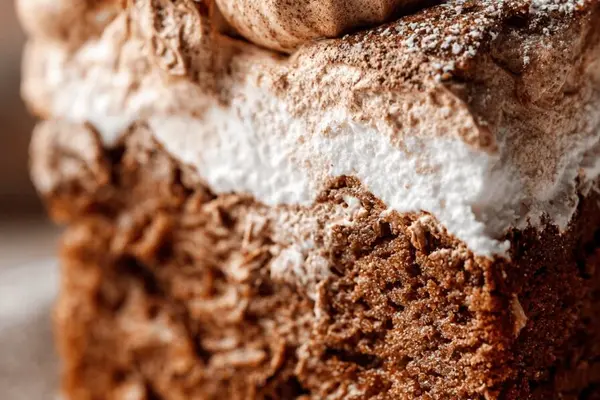
Coffee Swiss meringue buttercream layer cake with strong brewed coffee, whipped eggs, and cocoa. Silky espresso buttercream frosting meets chocolate meringue topping.
Prep:
30 min
Cook:
20 min
Total:
50 min
Servings:
8 servings
Fifty minutes total. That’s it for a cake that looks like it took half your day.
The coffee hits you first—brewed strong, turned into hot syrup, whisked into eggs until they stop being afraid of the heat. Then the butter goes in a few cubes at a time, and suddenly you’ve got something that holds a peak and tastes like it came from somewhere that charges fourteen dollars a slice. The meringue part is just patience. Low oven. Hours. But you’re not actually doing anything while it dries.
Why You’ll Love This Coffee Cake
Looks complicated. Three components, chocolate meringue sticks, the whole thing standing up like it knows what it’s doing. Takes 50 minutes of actual work—the drying part doesn’t count because the oven’s doing it.
Tastes better than it has any right to. Coffee buttercream hits different when it’s made the Swiss way—silky, almost mousse-like, not greasy at all. Chocolate meringue on top adds this crack-when-you-bite-it thing that cheap frosting could never do.
Works for any occasion. Birthday. Date night. Thursday. Vegetarian dessert that doesn’t taste like you made a compromise.
Stores fine. Wrapped tight in the fridge, three days easy. Some people say it’s better the next day. They’re probably right.
What You Need for Coffee Swiss Meringue Buttercream
All-purpose flour—300 ml, sifted. The sifting matters more than you think. Gets air into it.
Baking soda. Just 2 ml. Tiny amount. Don’t double it.
Five large eggs at room temperature. Cold eggs don’t emulsify the same way. Leave them out while you prep.
Granulated sugar—320 ml. Vegetable oil. A tablespoon of maple syrup. A tablespoon of milk. That’s the cake part.
For the buttercream: brewed coffee, strong. Two large eggs plus five yolks—so yeah, six yolks total plus two whole eggs. Unsalted butter, 400 grams, softened. Powdered sugar, 360 ml.
For the meringue: confectioners’ sugar, cocoa powder, five egg whites, cream of tartar. That’s it.
How to Make Coffee Cake
Heat the oven to 170°C. Grease a 42 by 30 centimeter sheet pan and line it with parchment paper—let the paper hang over two sides so you can grab it later.
Sift flour and baking soda together in a bowl. Set it aside. Don’t skip the sifting.
Beat eggs and sugar for about ten minutes. The mixture should be thick and pale. Like the color of cream. You’ll know it when you see it—it goes from yellow and thin to something that holds a ribbon when you lift the whisk.
Slowly add the oil while beating. Don’t dump it. Slow means it actually incorporates instead of making the batter look broken.
Fold in the dry mix with a spatula. Just until combined. Overmixing toughens the cake. Spread it into the sheet pan evenly.
Bake for eighteen minutes. It should be light golden—not brown, not pale. Golden. Turn it out onto a sugared parchment and let it cool completely.
Trim the edges. Cut it into four strips about 41 by 7 centimeters. Wrap each one tightly.
How to Make the Coffee Buttercream
Boil the brewed coffee with the powdered sugar until a candy thermometer reads 113°C. Takes maybe five minutes. Don’t leave it. Remove it from heat the second it hits temp.
In a separate bowl, whisk the two whole eggs and five yolks together until frothy. This takes a minute or two.
Slowly drizzle the hot syrup over the eggs while whisking constantly. Slowly. This is the part that makes people nervous. It shouldn’t be—the eggs won’t scramble if you drizzle, not pour. Keep whisking.
Whisk until the mixture cools down. Around fifteen minutes. The bottom of the bowl should feel room temperature.
Gradually add butter, a few cubes at a time. Let each addition mix in before adding the next. If it looks broken at any point—separated, curdled, wrong—keep mixing. It’ll come back together. Always does.
The buttercream should be smooth and hold a peak. Spread half of it on one side of each cake strip. Roll the first strip tight, place it upright on a serving plate. Wrap the next strip around it. Then the next. Then the last one. Wrap the remaining buttercream around the top and sides.
How to Make the Chocolate Meringue
Lower the oven to 75°C. Line two baking sheets with parchment.
Mix confectioners’ sugar and cocoa powder together. Sift it. Set aside.
Whisk egg whites and cream of tartar until soft peaks form. They should look foamy and hold a shape but still bend a little at the tips.
Gradually mix in the sugar you set aside. A little at a time. Beat until stiff peaks form—the meringue should stand straight up and not flop.
Gently fold in the cocoa mixture. Don’t stir it. Fold. Fold. Fold. You want it mixed but still light.
Pipe meringue into a round disk about 23 centimeters across on one baking sheet. On the other sheet, pipe about 40 sticks, each about 6 centimeters long. Use a pastry bag with a plain tip for the disk, a small one for the sticks.
Dry the meringues in the oven for about four hours. They should be crisp all the way through, not chewy in the middle. Let them cool completely before touching them.
Place the meringue disk on top of the cake. Attach the meringue sticks around the sides.
Coffee Swiss Meringue Buttercream Cake
Prep:
30 min
Cook:
20 min
Total:
50 min
Servings:
8 servings
Ingredients
- For the coffee cake
- 300 ml all-purpose flour, sifted
- 2 ml baking soda
- 1/4 cup vegetable oil
- 5 large eggs, at room temperature
- 320 ml granulated sugar
- 1 tbsp maple syrup
- 1 tbsp milk
- For the coffee buttercream
- 180 ml brewed coffee, strong
- 2 large eggs
- 5 egg yolks
- 400 g unsalted butter, softened
- 360 ml powdered sugar
- For the chocolate meringue
- 230 ml confectioners' sugar
- 90 ml cocoa powder
- 5 egg whites
- 1 ml cream of tartar
Method
- For the cake
- 1 Preheat the oven at 170 °C. Grease a 42 x 30 cm baking sheet, line with parchment. Let paper hang over two sides.
- 2 Combine flour and baking soda in a bowl. Set aside.
- 3 Beat eggs and sugar until mixture is thick and pale, about 10 minutes.
- 4 Slowly add oil, and incorporate.
- 5 Fold in dry mix with a spatula until just combined. Spread into the baking sheet.
- 6 Bake for 18 minutes or until light golden. Turn onto a sugared parchment and cool.
- 7 Trim edges. Cut into 4 strips, about 41 x 7 cm. Wrap tightly.
- For the buttercream
- 8 Boil coffee and sugar until a candy thermometer reads 113 °C. Remove from heat.
- 9 In a bowl, whisk eggs and yolks until frothy.
- 10 Slowly drizzle hot syrup over eggs while whisking. Whisk until mixture is cool, around 15 minutes.
- 11 Gradually add butter, a few cubes at a time. Mix until smooth.
- 12 Spread half the buttercream on one side of each strip. Roll the first strip, place upright on a serving plate. Wrap next strip around it, repeat with other two.
- 13 Cover the top and sides with remaining buttercream.
- For the meringue
- 14 Reduce oven temp to 75 °C. Line two baking sheets with parchment.
- 15 Mix together confectioners' sugar and cocoa. Sift, set aside.
- 16 Whisk egg whites and cream of tartar until soft peaks form.
- 17 Gradually mix in remaining sugar. Beat until stiff peaks form. Gently fold in cocoa mixture.
- 18 Pipe meringue into a round disk about 23 cm on one sheet. Make about 40 sticks on the other, 6 cm long.
- 19 Dry meringues in oven for about 4 hours. Cool before placing meringue disk on cake's top. Attach meringue sticks around sides.
Nutritional information
Calories
400
Protein
6g
Carbs
45g
Fat
24g
Frequently Asked Questions About Coffee Swiss Meringue Buttercream
Can I make this without a candy thermometer? Not really. The syrup needs to hit 113°C. Too low and the buttercream breaks. Too high and it tastes cooked. Thermometer is worth it.
Why won’t my buttercream come together? Temperature mismatch. If the eggs are still too warm when you add butter, it’ll separate. If the butter is too cold, same thing. Room temperature matters.
Can I use instant coffee instead of brewed? Yeah. Dissolve it in water. You need the liquid. Tastes fine either way.
How long does it keep? Three days in the fridge, wrapped tight. Could probably go longer but I’ve never waited that long.
What if my meringue sticks break? They break. They’re fragile. Make extra. Twenty sticks, not fifteen. Some won’t survive from oven to plate.
Do I have to use egg whites for the meringue? Yes. That’s what makes it meringue. If you don’t want raw eggs, dry them low and slow like the recipe says. Four hours kills any worry.
You’ll Love These Too
Explore all →
Cinnamon Chocolate Bark with White Chocolate
Buttercream Lemon Pound Cake Recipe

Roast Chicken with Carrots, Beets & Cherry Tomatoes
Vegetable Soup Recipe With Carrots & Green Beans

Roasted Root Vegetables with Tofu & Barley

Sesame Seared Tuna with Volcano Sauce

Slow Cooker Cranberry Meatballs Recipe

Olive Oil for Dipping Bread Recipe
Peanut Butter Jam French Toast Sandwiches
Oreo Oreos: Red Velvet Cream Cheese Cookies
Oreo Chocolate Mint Shake with Vanilla Ice Cream

Jello Shot Recipes with Strawberries & Rum
Buckwheat Waffles with Sunflower Seed Flour

Lentil Wonton Tacos with Chipotle

Lemon Chicken Thighs with Vermouth Sauce
Apple-Stuffed Maple Dumplings with Cinnamon

Mexican-Style Dips with Guacamole & Cucumber
Lamb Dishes Middle Eastern: Crispy Kibbeh
Beef and Broccoli Recipe with Flank Steak